
Nina Serrano tells the story of her 1957 journey to the 6th Festival of Youth and Students in Moscow, USSR, and her trip to China where she met Chou En-Lai, the first Premier of the Peoples Republic of China and a founder of the Chinese Revolution. This interview was recorded in 2016 in Vallejo, CA.
From the Interview:
“In 1957 . . . a former student named Jerry came through town and he came by to look at my baby and say hello. When he heard I was running the Student Peace Center that I was its president, he said, “Oh you’re a student leader, you should come to the Moscow Youth Festival for Peace and Freedom, international meeting and it’s going to be in Moscow for two weeks.”
Moscow On the Way to Meeting Chou En-Lai
“Well that was amazing and before you knew it, I was on my way to Moscow for two weeks to be a delegate to the International Youth Festival for Peace and Freedom.
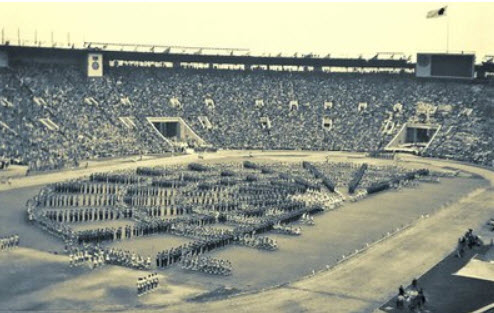
“There were probably about 240 or 250 Americans and I probably met most or some of them, but more importantly I met the people of the world, the youth of the world. For the first time in my life, I met someone from Vietnam, a beautiful, very delicate and petite woman in beautiful silk and embroidered clothes with long hair with a beautiful voice, who I spoke with through a translator. She told about her life and movement and I told about mine. I was very very impressed with that. I didn’t even know where Vietnam was and I think it was called Indochina is how she was presented to me. Then, because of my affinity for Spanish, I would sometimes eat with the Latin American delegation. There were only a few of them like maybe 18 or 16 and I don’t remember them one by one, but through my reading of history, I found out that many of the leaders of the progressive movements in Latin America were on that delegation, including someone who would later be my friend Roque Dalton from El Salvador and Carlos Fonseca Amador, the founder of the Sandinista Movement in Nicaragua.
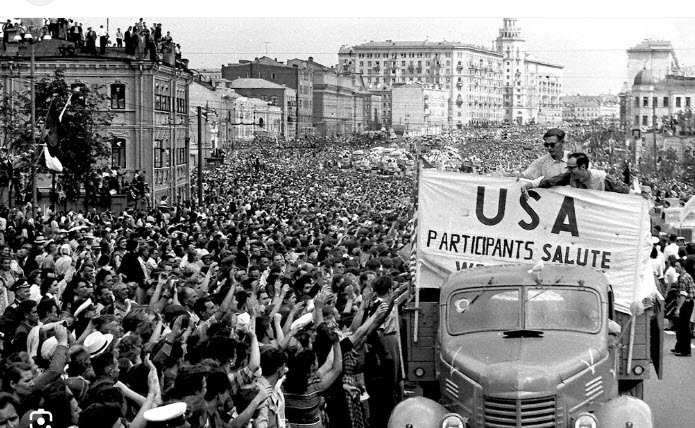
“At that moment, they were just young guys, full of song, full of jokes, very flirty and fun to hang out with, whereas the American delegation wasn’t so much fun to hang out with because they tended to have all these political arguments. It seemed to me this was the moment for getting beyond political arguments and making real people contacts and learning what other people in the world were like. I can see that the food was fantastic. Every morning, I would have sour cream and black caviar for breakfast and there’d be bowls of it there at lunch and dinner, so I think I mostly ate that all the time and delicious thick breads. It was a festival full of song and there was even a festival song that we say in all the different languages. I found that so moving and it was a moment when it seemed like the world might just explode, maybe like this moment, where it feels like the planet will be starved out of clean water and clean air. Then, it was the fear that because the Soviet Union had the atomic bomb and the US had the atomic bomb and they were such enemies, dedicated enemies that the world would explode through these atomic and hydrogen bombs.
Invited to Go to China
“At the end of the two weeks, somebody came over to our dormitory and invited us to go to China, saying that if we wanted to take a look at the Chinese Revolution, which had just happened in 1949 and this was 1957, so relatively sooner, was a more recent revolution, where the Russian Revolution had happened in 1917, so that was far from its revolutionary roots, where China was developing its revolution. They invited us. They would take us by train through China and then we could pick up our flights back from whatever tickets we had.
The State Department Objects
“Well, before we ever got to the train ride and while the invitation was being made, we were also visited by the US State Department, who declared that this was a terrible terrible thing that it was forbidden to go to China. I was very outraged to think that I didn’t have the right to travel that I had a passport, a US passport, which is such a valued object in the world. Yet, there were places that I was not allowed to go with it. This outraged me and also they threatened us of what might happen to us if we were to break that travel ban. The travel ban to the Soviet Union that year had only been lifted the year before. It had actually been illegal for Americans to go visit the Soviet Union, so even visiting the Soviet Union when we did in 57 just a year after the lifting of the ban, it was still a very not approved of thing. Only 42 of us took up the Chinese invitation and off we went.
Trans Siberian Railroad
“To go to China, we boarded the trans-Siberian railroad, oh just the name of that filled me with excitement, the trans-Siberian railroad, so many murder mysteries and adventure stories of the era or the earlier era had taken place on the trans-Siberian railroad. It was quite an experience. It was a 10-day journey from Moscow to Peking. Tea was served on the train and it was the festival train, so car by car was filled with the youth of different countries and you can imagine as a young person the fun of running down those corridors and meeting other youth from different countries in the different cars. I would run down to the Latin American car and hang out with those guys. The porters on the train would come and serve us chai, which was tea. We passed Siberia. I looked out the window and I was in Siberia, but actually I was just in a thin cotton, an Indian print wraparound skirt and new fabric that had just come out called drip-dry [inaudible 00:41:21]. You didn’t have to wash it, but it looked like cotton, so this little thin blouse and orlon sweater, another new fabric that you just had to rinse out.
“I was not cold because I had always thought Siberia was the kind of place where you would freeze to death, but of course it was autumn, so it wasn’t that cold. When we’d look out the window, we’d see log cabins and it looked kind of like the western frontier and then wonderful people would greet us with flowers at all the stops and sing us songs and hand us sausages and breads through the window to keep us going.
Theater in China
“One thing I did in China was to hook up with one of the translators who turned out to be a young woman from Greenwich Village in New York. She was totally saturated any arts and I told her that my main interest was theater. Well, she loved theater, so she arranged that sometimes when other people, when the whole delegation was maybe going to look at a mine or look at a factory or construction site, we were going off to the theater and to theater training schools in every province that we visited and in every town and she was by my side, translating. I saw a lot of the training of actors and it was awesome. It was beyond anything I’d ever imagined as a student of the Stanislavski method, which is kind of realism theater to see the kinds of theatricality that I saw in China just blew me away and to see what was demanded of the Chinese actor. The Chinese actor was an acrobat, a singer, a person able to do things larger than life and not at all bound by realism. At the same time, in many of these operas, they had incorporated the new ideology, the socialist ideology.
“They would incorporate stories that would prove the point about maybe class struggle or about working together cooperatively. They would weave in the ideology, but still in the format of the old traditions and how highly skilled their performers were that really amazed me, the dedication and the skill and achievement of the Chinese artists.
Meeting Chou En-Lai
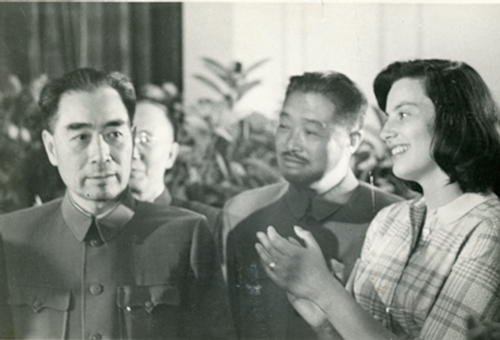
“Meeting Chou En-Lai was something was arranged by whoever was facilitating our trip. It was just one of the many many many formal meetings. Fortunately, we were youth, so there was no rest on this two-month journey. We were constantly visiting factories, schools, prisons, theaters, childcare centers, seeing construction sites. We were always seeing how the country was developing and so on. One of those assigned trips, we arrived somewhere and there was a ceremony going on and [inaudible 00:43:30] was there and right away, there was something special about him that I remember to this day that was 1957. His composure, his quiet confidence and his friendly aura and he smiled at me and said in English, perfect English, “Hello, where are you from?” That kind of encounter, very limited, but very memorable because of his warmth and intelligence, charm.”
 Send to Kindle